“Debbie Gibson and dog food. I’ve always dreamed of this.”
— Julie Brown, Just Say Julie!Yesterday, one of my co-workers mentioned that he might miss the morning meeting because the construction on his street was so annoying that he was going to drive down to his parents’ house in Salinas to work. Spotting this, I suggested lunch. Proving that I’d picked the right group to work with, he suggested The Meatery’s deli.
His parents live at the south end of Salinas, so it was a lot closer for him than for me, but c’mon, with a name like Meatery, of course I’m going.
They’re primarily a butcher shop and have no indoor seating, and of course Covid, so we parked our cars side-by-side and ate outdoors in the sunshine.
Next time, we’ll have to pick something closer to my house, but next time I’m in Seaside, I’ll definitely eat there again.
If you don’t want to be accused of shenanigans, don’t do things that look like shenanigans. Sounds simple, doesn’t it?
Also, don’t spend four years actively engaged in obvious shenanigans and then accuse your target of being paranoid.
Adjacent articles on Slashdot:
I guess Android’s too old to run Netflix now? 😁
If your election stays up for more than four days, consult Rio Teramoto.
As for the ongoing clusterfuck that is the US presidential election, Larry Correia weighs in.
In the nearly-there Big Sur release of MacOS, Apple won’t allow third-party software to even see the network traffic from their applications and services, much less block it. If, for instance, you’re on an expensive or slow wifi connection, and iCloud or Software Update decides to slurp up all your bandwidth, well-known tools like Little Snitch, TripMode, and even your VPN software won’t know about it.
I haven’t seen anyone mention tcpdump or Wireshark yet.
Remember: it ain’t over until the body-positive female-identifying person expresses themself vocally.

I just had to delete and re-add my Gmail account to Apple’s Mail.app, because they were arguing so fiercely about moving a single message between IMAP mailboxes that my fans spun up to full speed and stayed there for well over an hour.
To vote in person in California, as I just did, you must not only surrender the ballot that was mailed to you on the sole authority of the governor rather than by any law, but also the empty return envelope that came with it. No voter ID, though; that’s crazy talk.
I experimented a bit with Meshmixer to optimize the orientation and supports for a model before slicing and printing with Dremel’s software. Pro: it was easy to remove the tree-style supports it generated. Con: the surface quality was no better for all the extra work involved, and actually required a bit more sanding to be usable.
So I tried the current version of Cura (which has a bewildering array of tree-support options) with the machine definition copied from Dremel’s older version and the built-in generic filament and quality definitions. The print took just as long as with the Dremel software, but practically crumbled in my hand. All the small parts could be snapped off with very light pressure, and the main body’s 20% infill wasn’t enough to survive squeezing between thumb and forefinger. Definitely need to import the Dremel-specific filament and quality settings before I try that again.
Then I tried to decipher the UI for Autodesk Fusion 360, which honestly looks like it was designed to sell training classes. Also, it has a fairly short list of available machine, material, and quality profiles, so I’d have to enter everything by hand for my printer. Yeah, no. If I can manage to figure out how to use it before the mouse bindings drive me to throw a laptop out a window, I’ll try designing a part and exporting to Dremel’s software. It also really, really wants to keep everything in their cloud, which you have to manage from a real browser; it took me a good five minutes to figure out how to completely delete one accidental upload.
Then I took a brief look at FreeCAD, where instead of having their own UI paradigm, they simply emulate everyone else’s and allow you to pick one. Or more. Initial impression: the 2D tools make Illustrator look like the easiest-to-learn drawing software in the world; I didn’t get to the 3D tools. I did like the Bézier curve visualization, though.
CorelCAD is a full-featured 2D/3D package, and for $700 it ought to be. In prehistoric times I found CorelDRAW a lot easier to learn than Illustrator and used it a lot, but then they had a very, very buggy major release that drove me away, and I never looked back. They have free trials of all their software, and a subscription model for some of them, but the very first question on their FAQ page is:
’nuf said.
The Dremel’s camera went offline during one of my prints, and since nothing was listening on the port, obviously the software had crashed on the printer. There’s nothing checking for this and restarting it, so the only way to get the feed back is to power-cycle, which had to wait until I was done sending test prints for the day. The printer still printed, and the status API kept reporting correctly, so it was no big deal. Their app doesn’t really know what to do when there’s no video feed, but it still functions.
By the way, extracting the Busybox image from the latest firmware
update and running strings on the binaries revealed a few additional
commands in the API: GETJOBSTATUS, CANCEL, PAUSE, RESUME, NOZZLEHEAT,
PLATEHEAT, STOPNOZZLEHEAT, STOPPLATEHEAT; I have no need to try most
of those out. A quick tcpdump while I was driving it from the GUI
showed the two-part command to print across the network: you upload
the file by POSTing to /print_file_uploads with name, filename, and
data fields, then POST PRINT=filename to /command (and then spam
it with GETPRINTERSTATUS every few seconds, at least if you’re
Dremel’s software).
So, if I ever get another slicer that generates good code for this device, I won’t have to walk the gcode over to the printer on a thumb drive, through the snow, uphill both ways. That will matter more once I move it upstairs into my office, because while it’s not loud, it is audible, and there doesn’t seem to be a way to turn off the built-in lighting. Closing the office door will make lengthy overnight prints less intrusive.
…unless I ever have a houseguest again, because the guest bedroom is right next to the office.
…unless the guest is my sister, who stubbornly insists that my couch provides a much better sleeping experience. Honestly, if I ever win the lottery and build my dream house, her room will just have a sectional sofa, large-screen TV, and a bookshelf. And excellent wifi coverage. Maybe its own kitchen. Oh, what the hell, just make it a studio apartment without a bed.
If it ever becomes possible to play tabletop games in person again, mz4250’s extremely large set of free miniatures will be useful. The detailing on some of them is nice enough to scale up for decoration, and it’s not just the complete set of D&D monsters and an ever-increasing set of module-specific characters. There are other genres, as well as disturbing nightmare creations.
I think I’ve gone down enough software rat-holes for now. Back to just coding up shapes in OpenSCAD and printing them with the supplied software and its “old-fashioned” support structures.
Remember when everyone was up in arms about the antibiotic-resistant bacteria crisis, and we all needed to stop using antibacterial products right now? Corona-chan really kicked the pins out from under that campaign. Now it seems like everywhere you go, assuming you’re allowed out, there’s a hand-sanitizer station every 20 feet, and every public surface is being wiped down dozens of times each day with strong disinfectants.
On the off chance Trump beats the margin of fraud, I’d like to remind everyone in the “punch a nazi” crowd that A) you’re not very good at nazi-identification, B) the ‘nazi’ gets to punch back in self-defense, or shoot if your attack is serious enough, C) you’ll be the one facing felony charges, D) if you go out in force to protest the election results, 10USC331 could make those charges federal, which means no catch-and-release by the local po-po, and E) that felony conviction may stop you from voting or owning guns.

Turns out Dremel’s software is based on Cura 2.7, and the current version is 4.7. Settings extracted from the various resource directories don’t quite work as-is, due to substantial changes over the past three years. Cura silently ignores non-compliant materials and settings files, so a bit of trial-and-error will be necessary. I was able to import the basic printer definition by changing two lines, but not the materials or quality settings.
I’m honestly surprised this hasn’t been done by someone yet. It’s not hard, just tedious, and there will likely be times that the features in the newer software will be useful. I haven’t found anything wrong with the current version, but 3 years is a long time in this sort of software.
On the plus side, getting direct network access to the Dremel’s status and video without using their app is refreshingly easy:
# retrieve status as JSON
curl -d GETPRINTERSTATUS $IPADDR/command | jq .
# watch the video in any browser or VLC
http://$IPADDR:10123/?action=stream
Looks like you can also upload files and start print jobs through this API, too. Downside: so can anyone else on your network. Not a problem for me, fortunately.
On a whim, I installed Slic3r to try it out, but when I launched it, the embedded Perl interpreter started grinding on my CPU. I couldn’t decide if it was mining cryptocurrency, encrypting my hard drive, or just bad code. The latest 1.3.1-dev release started up instantly, which is suggestive. As a true open-source project, it comes with a completely empty printer and materials library, making it more of a lifestyle than a tool.
I searched Pixiv for a nice 3D-created illustration to insert here, but the ones that weren’t loli porn were bondage porn, so here’s a perfectly innocent picture from Genshin Impact.
The Internet Archive has implemented “fact checks” and “context” for The Wayback Machine. They now confirm that the chocolate ration has been increased to 20 grams/week.
A few quick comments on my new Dremel 3D45:
The documentation is laughably terrible, even supplemented by the online support pages and videos. Between the two, you can manage to get it up and running correctly, but everything was very clearly done by tech writers for a power-tool manufacturer, not by a consumer-electronics company.
Why, yes, I did manage to misfeed my filament the first time, resulting in a small test print that looked like it came out of one of the first low-budget 3d-printer kits on the market. Fortunately I knew what a skipping stepper motor sounded like, and was able to quickly abort the print and start over.
The touchscreen is kinda cheap for a $2,000 printer. Clear and bright, but only responsive to slow, firm touches. Entering my 52-character wifi password (three times) was quite painful.
And, yes, I had to set up wifi even though I had an ethernet cable plugged in when it booted the first time.
By the way, all the documentation insists that there is no LAN printing support, and that if you want to print without a USB cable or thumb-drive and watch your job through the built-in camera, you must connect to their cloud. Neither of these statements is true. Works great, auto-detects printers on the local LAN (wired or wireless), shows the progress and remaining time, and the camera even includes the filament spool in the frame so you can visually confirm that you’re not running low.
Also, their cloud setup got stuck in an endless SSO-auth loop. Yeah, fuck the cloud.
The bundled software, which initially seems a bit limited, is in
fact quite competitive, being built around the open-source
Cura package, which means
that it includes the ability to read .fdm_material files for a
wide variety of third-party filaments.
Dremel also supports and recommends Simplify3D, which is well-regarded despite its complete lack of anything resembling a material library. It has a basic profile for the Dremel models, but doesn’t even support the material that comes in the box.
That is, Dremel officially sells and supports branded PLA, PETG, Nylon, and Eco-ABS (actually a modified PLA with a confusing name), and ships the printer with one spool of Eco-ABS and one of PETG. Simplify3D’s device profile lists PLA, ABS (apparently Eco-ABS), and Nylon; they don’t include PETG in any of their profiles, and do not clearly document how to add additional materials, although they have web pages describing common parameter ranges for many generic types of filament.
One last note on software: Simplify3D requires an active Internet connection at all times to work, and their “free trial” involves giving them $150 up front and asking for a refund within two weeks. Yeah, fuck that.
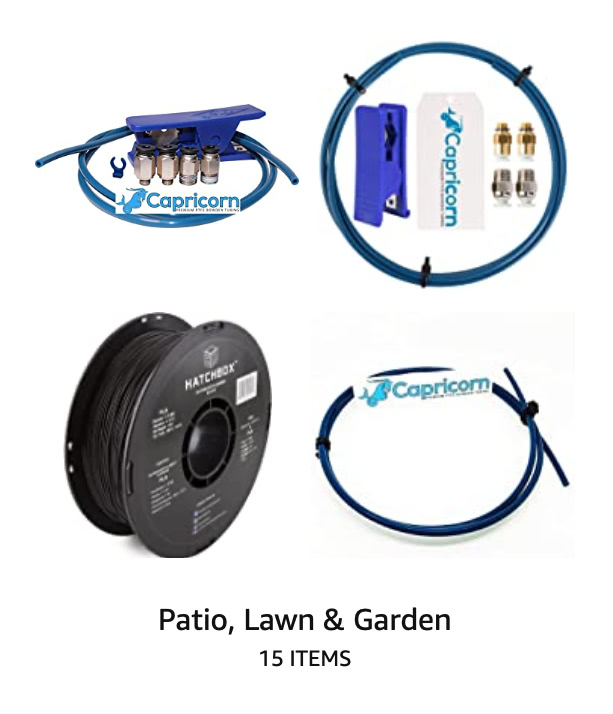
Note that third-party filament, while supported, has to be rewound onto a Dremel-sized spool before use, and you’ll want to remove the RFID tag so the printer doesn’t auto-detect it as the wrong stuff. There are plenty of designs on Thingiverse for assisting with this process.
By the way, Dremel says they’ll send me two free rolls of filament for blogging a review of my printer. “Your proposal is acceptable. Especially since I was going to do that anyway.”
Update! Just noticed that Dremel’s software also auto-detects thumb-drives as a destination to save your gcode, and offers an eject button after the copy finishes. That’s convenient.


Why, yes, I did name it Ricotta; she’s a pro maker, dawg. Er, “pro maker dog”.
My first print job was a redesigned koma for the baby takadai. 30 minutes at medium quality, 30 more minutes after I broke one of the pins off while remembering how to cleanly remove the supports (been a few years since I used one of these, and the documentation consists only of the words “use needle nose pliers”), and I had a part that fit perfectly and worked exactly as intended.
I had it print 9 more overnight, and woke up to a full set of koma much better than what that poor woodworker had managed with a router, a drill press, and not nearly enough time to get them all out the door in time for the conference.
Note that the 3d-printed design does something that would have been a real pain with a drill press: the front pin is exactly at the front, so there’s no double-width gap between pins on adjacent koma. I swiped the idea from the Braidershand design, which gets very close to the front of the koma with their pins. Little touches like that are why their gear has an 18-month waiting list.

Second job was a gravity ratchet and pawl downloaded directly from the McMaster-Carr online catalog. I’m going to scale and recreate this design in OpenSCAD to use for the take-up reel in my next babydai mod.

For the third job, I had a sudden inspiration about how to solve the problem of tensioned threads falling into the narrow gap between two koma: curve the ends. This took longer to work out on paper and in OpenSCAD than it took to print in high-speed draft mode (30 minutes for two).

They came out exactly how I expected, and I was quickly able to confirm that the idea was sound, but I really wanted the curved ends to go the other way…
Thirty minutes later, I had another pair of prototypes.

At this point, I have full confidence that the Dremel 3D45 will reliably deliver excellent 3D prints with their branded filament, and that I should be able to successfully import working settings for common third-party filaments when I get around to buying some.
The hardware is solid and well-designed, the software is quite capable, the filament seems to be of decent quality (if a bit hard to find right now, between Corona-chan and their change from 500-gram spools to 750-gram), and the price is reasonable for the feature set. The packaging is excellent, by the way, and easy to reuse for travel or repair.
I haven’t used the High or Ultra quality settings yet, or increased the infill percentage; Medium/20% was smooth enough and strong enough for koma with 1/8-inch pins and small weighted tama. High-Speed (draft) is kind of ugly and a bit stringy, but does what it’s supposed to.
My next project will be a more significant drop-in mod to the baby takadai, relocating the torii, take-up reel, and sword pads, unlocking the ability to use all those new koma I printed and make much wider braids with up to 48 weighted bobbins. I’ll be releasing the OpenSCAD models and STL files so that any of the other conference attendees can mod theirs. Given the crowd, though, I’ll likely also end up printing a few sets to send people. 😁
After that, well, as much as I love the capacity of the 22 9-pin koma on my Braidershand takadai, I also like to braid with thick yarn, and my first attempt at that made me wish I had a set of 6-pin koma with big wide gaps between pins. And since my OpenSCAD design is parametric, that’s just a few long print jobs (roughly 5 hours and 38 grams of filament, each). Hardly a project at all. I’ll probably do them in white; black would be pretty harsh against maple.
Then there’s that complete parametric takadai design I did a few years back, which could be easily framed with connectors like Jonction P. And the long list of CNC projects I still haven’t gotten to. And this idea I just had for an easy tilt/shift adapter for my Sony a6500 and an old Mamiya 6x6 lens. And…
I briefly toyed with the idea of designing parametric boxes for tama storage, since I have large quantities of bobbins in different sizes, weights, and shapes (236 total at the moment, but there will be more someday). Then I went to Michaels, based on a tip from the recent kumihimo conference. Their 99-cent crayon boxes hold 4 standard-size tama, their $1.99 pencil boxes hold 10, a larger pencil/craft box holds 9 large tama, and somewhere else in the store I found boxes that were perfect for holding 16 of the latest thing in affordable tama (another conference tip).
I don’t think I’ll need any more tama or boxes this year, but there will come a day when I’ve got 60 of one weight on the big takadai, 39 little ones on the babydai, 32 on the big marudai, 9 on the little marudai, and three dozen cats to feed.
Unrelated, this is the first time in 20 years that I have had zero trick-or-treaters, down from the usual ~120. I bought a few pounds of candy just in case, but especially since I’ll be working from home until June, I didn’t risk a big buy.
Fans spinning up on your Mac laptop during high network traffic? Apple ships a user-mode driver for common USB-C and Thunderbolt docks.