“Our election was hijacked. There is no question. Congress has a duty to #ProtectOurDemocracy & #FollowTheFacts.”
— Nancy Pelosi, announcing her plans four years in advanceKitten Pile!
Okay, these kittens are technically adults, and one of them’s almost 30, but when you’ve got a few decades on them…
Dear Waze,
One of these things is not like the others…
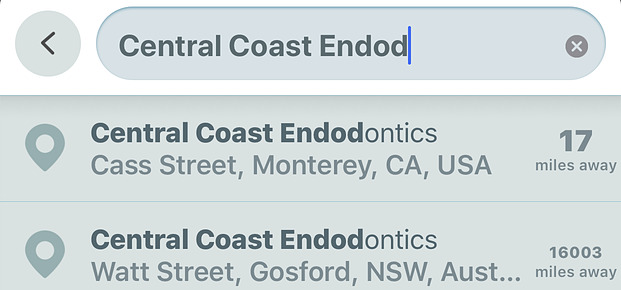
At least this one is obviously wrong, unlike the time I asked it to take me to the Embassy Suites SFO, and eventually discovered that there are two of them, about ten minutes apart…
Pixiv: Yuri
The 百合 tag at Pixiv starts at “two girls in picture”, passes through “friendship” and “obvious attraction” on the way to “making out”, and ends up at “hardcore lesbian pr0n”. That last one is generally not canon for the characters depicted, even the ones also tagged 百合夫婦, “yuri married couple”.

Does. Not. Work.
Not only is it rather difficult to hold a katana in this position, what would you actually do with it from there? You can’t swing, you can’t block, you can’t thrust, and if you hold the position for very long, you’ll get a cramp. About the best outcome you can hope for is shaving your own cheekbones.

PDF::Cairo example output
I’ve been adding example code to PDF::Cairo. Here’s the output from what I’ve got so far:
-
2019 Progressive Calendar, a much-cleaner version of the script I wrote in March.
-
Box-slicing test, not actually useful for anything.
-
Image-loading test, ditto. (new! improved! fixed translate/rotate/scale order to get rid of skew)
-
Inkle drafting grid, planning tool for Inkle weaving. Reimplemented from here, using my Box library and polygons rather than my hand-tuned, impossible-to-debug component method. About 12x larger output, but Cairo isn’t a PDF library, it’s a library that can output PDF, so you don’t get as close to the metal.
-
Isometric drawing pad, mixes my Box library with a bit of trig to clean up the grid layout.
-
Kanji practice sheet, currently blank; I plan to add a second example that fills it in with selected characters in a pen font, grayed-out so you can draw on top of them. It’ll be much cleaner than the version I wrote ~14 years ago.
-
Sample Pango layout, showing the use of its markup. Now includes glyph outline support.
-
NEW! Glyph outlines, including manually processing the drawing operators.
-
New! Traveller hex grid. Unlike my 15-year-old sec2pdf script, which I threw together over a weekend when I discovered how terrible the existing Traveller mapping tools were, this one actually centers the grid correctly on the page. (seriously, before sec2pdf, the way to create a PDF Traveller map was to run a DOS program that spat out an import script for an obscure 2D free CAD program, then let it run for 10-20 minutes; these days it’s a lot better, although the border definition method I came up with is still in use)
A Thousand Words...
Naughty words, that is.

APFS considered harmful...
…or at least “not ready for prime time”.
It seems I wasn’t quite correct in my assessment of why my MacBook was sluggish. Full-disk encryption was indeed having a visible effect on performance, but even after turning it back off, I’ve still been seeing some pretty awful performance… after a few days of uptime.
There are two primary symptoms, both connected to filesystem performance: first, Time Machine backups take progressively longer each time (no matter how much data is being backed up), until it starts reporting that a typical 300MB backup will take more than an hour; and second, image-heavy web sites start loading very slowly, with JPEGs showing up ‘blocky’ while they’re rendering. If I don’t reboot when I detect these two issues (usually after about four days of uptime), then I’ll start having difficulty mounting and unmounting external devices and network volumes, and Disk Utility will show a SPoD. I’ve had to disable automatic backups, because I can’t put it to sleep until they finish (Time Machine will cheerfully corrupt your backup history if you disconnect from the file server while it’s running).
My recent vacation makes it difficult to be sure, since I turned the MacBook off after every use, instead of my usual “leave it up until it crashes”, but I think this is specific to the OS 10.14.4 release.
With all the problems they’re having with hardware and software, it seems the old cliché about “there’s no I in TEAM” could be rewritten as “there’s no QA in APPLE”.
Related, when I do reboot, the first thing I do is open top in a
Terminal window and wait a minute or two until the load drops from ~50
to under 5; then I kick off a backup and start working.
Update
After a lot more testing, it seems that APFS is only responsible for about a third of the slowdown. The rest is coming from the TCP stack. Rebooting is still the only fix; I’ve tried switching between wired and wireless, changing out the USB-C ethernet adapter (I have like five brands of them, between home and office), manually resetting the interfaces, etc, etc.
If I work completely offline, local I/O still slows down over a few days, but if I’m online, network I/O gets worse faster. Still a problem after the 10.14.5 update, and I’m thinking it’s specific to the 12-inch MacBook hardware, since I don’t see it at all on the 15-inch MacBook Pro that’s usually on the other side of the kitchen table.
Pixiv: Work illustrations
[Back over the net to you, Brickmuppet!]
Mixed in with the fan artists at Pixiv are a lot of pros, posting excerpts from the various games, manga, and light novels they do work for. Browsing the 仕事絵 tag is a good way to find quality cheesecake.