“Octopuses are very intelligent, but they’re also unsociable, short-lived, and prone to cannibalizing their peers. That makes them unique in the animal kingdom, according to scientists who have evidently never met any grad students.”
— Robinson Meyer"Hey, I know that voice!"
Finished watching Kanata No Astra (which really needed 18 episodes, but got 12, with 2 of them double-length), and when Ulgar’s brother got some screen time, I immediately recognized his voice as a very different character: Dennis Elbaji, from the first story arc in Cop Craft.
What didn’t hit me while watching either show was that it was the same voice actor as Kane McDougal from Mouretsu Pirates. Also Dionysus from Sword Oratoria and the DanMemo mobile game (a character who admittedly doesn’t get a lot of lines).
Kanata, of course, is another voice I hear a lot of, as Welf Crozzo. And Aries is Hestia, Yunhua is Ryu, Polina is Tsubaki (Sword Oratoria), and Ulgar was Soma (DanMachi 2).
Another interesting note: the primary scriptwriter for the series was the creator of the School Live! manga.
Sadly, fan-art of this series is pretty limited. There’s some inept porn, some awkward attempts at drawing something that resembles one of the characters, and maybe five decent pics of the girls. Nothing like, say, an extended remix of the bikini paradise scene.
The thing that makes episode 12 so unsatisfying is that they wrapped everything up by telling, not showing. Laying it out all at once as talking-heads scenes highlighted every weakness in the backstory, drawing attention to elements that frankly don’t work. Playing it out over, say, 4 more episodes would have improved the story by letting them reveal less about the universe.
Seriously, “we established a world government that abolished guns, religions, nations, languages, and the history of the world, and all of the survivors went along with it for the rest of their lives. Also, abolishing guns (except the world government’s, who never lets them fall into the wrong hands or abuses their monopoly on force), religions (nobody cares enough about those to ever, y’know, worship in secret and have their faith strengthened by persecution), nations (trivial!), and languages (even more trivial!) created lasting world peace.”
“And we all agreed to hide the secret of wormhole technology by leaving it in the hands of the company who invented it and made themselves royalty, despite the fact that they somehow let it fall into the hands of random terrorists and criminals who were responsible for accelerating the fall of Earth.”
…and that’s just the parts I noticed while they were plotsplaining. If I actually went over episode 12 and compared it with what we were shown at the start of the series, I think it would come off a hell of a lot worse. I just don’t want to, because I liked the parts leading up to that point.
Weasels gotta weasel
It is indisputable that the Google Chrome updater crashed thousands of Macs, primarily those used by video production studios. FFS, the smoking gun is right there in their updater logs:
GoogleSoftwareUpdateAgent[1213/0x7fffc9d683c0] [lvl=3] -[KSLockFile(PrivateMethods) deletePathIfSymlink: except: ] Found and deleted symlink at path /var
And it logs an error message if it can’t delete /var, which means nobody in Google QA reviews log errors before saying “ship it!”.
But how did they spin it? (emphasis mine)
“a Chrome update may have shipped with a bug that damages the file system on macOS machines with System Integrity Protection (SIP) disabled”
There are reports that it has affected people who have SIP enabled, which seems to be due to them having gone through multiple OS upgrades, starting from a version that didn’t have SIP, with permissions somehow getting changed from the defaults over the years.
The reason it hit video studios so hard is that they were all running external Thunderbolt 2 GPUs to accelerate Avid, and to run the required unsigned kernel drivers, they had to turn off SIP.
Pixiv Champloo 8
A little something to stir up my Pixiv recommendations, which are a bit heavy on foxgirls after that last post.

Not from The Babylon Bee...
Landfill Road with ‘Putrid Stench’ to Be Named After Barack Obama
The SFGate source for the story leads with the Republicans Pounce angle, of course.
Divine Diversity
In the DanMachi universe, the economy of Orario is adventurer-driven. Not only do they protect the city (and the world), the magic stones that monsters drop are the basis of all technological advancement, and their most lucrative export. But to get magic stones, you need adventurers, and to get adventurers, you need gods to provide their blessings.
So when the gods make requests…
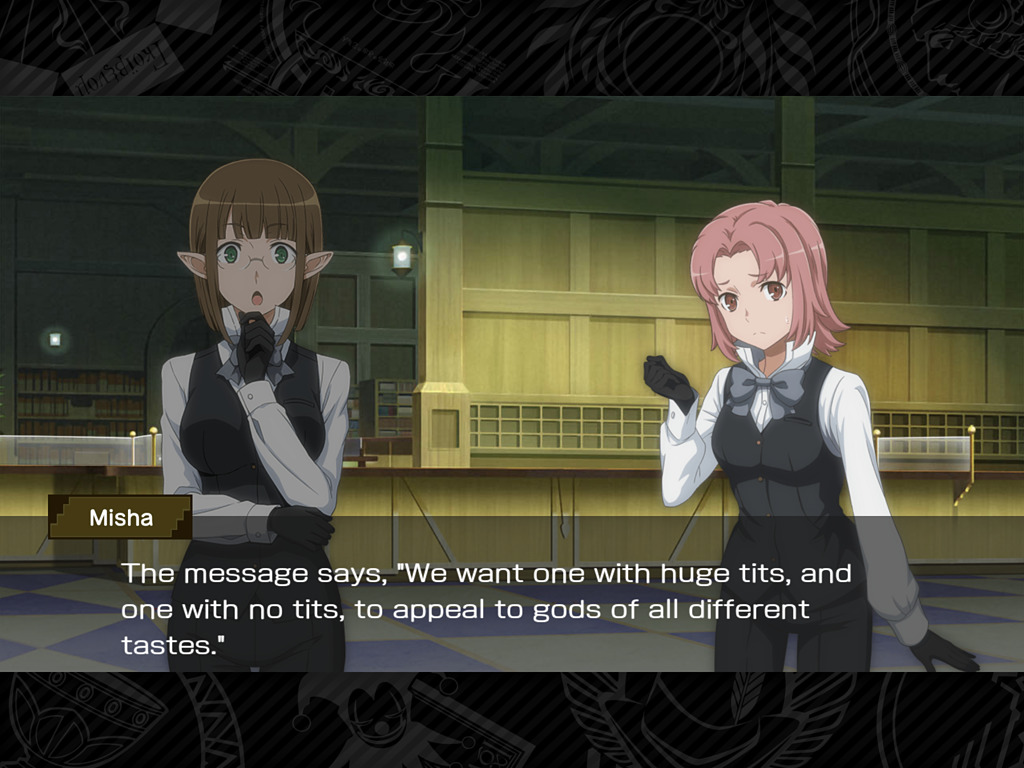
(from the mobile game)
The novelist came up with a pretty good way to make sense of classic fantasy RPG tropes, but while he’s fleshing that out and exploring some of the darker implications in the side series, if you really step back and look at it, the ugliness and brutality goes to the bone.
All those sweet, pretty guild advisors are sending children to their deaths every day. Not just in the sense that the gods view all their followers as “children”, but young teens and tweens, and if you look around in crowd shots, sometimes much younger. How long do they last, before it hits them that the upper levels are a meat-grinder lined with the bones of the kids they sent in?
It’s not a story I’d enjoy nearly as much as the cheerful harem comedy we got, but sometimes I think about how the world we’re not shown is seriously fucked-up.
Good Eats! The Return 7-10
Don’t ask me why the episode list on the Food Network web site is in a completely different order from how they’re actually airing. By air date, the most recent episodes are:
- 7: Oyster poor boy sandwich
- 8: Steak tartare and poké
- 9: Dates (stuffed; sticky toffee pudding)
- 10: Sourdough (cheese crackers; waffles; post-apocalypse)
All entertaining to watch, none of them things I’ll ever make.
Three more to go (one double-length) before we’re back to reruns, although there’s the promise of more revised classic episodes.
Finally, Alita
One of the side effects of having the power go out Saturday night was checking the Amazon app on my iPad to see what I had downloaded, and suddenly remembering that I hadn’t watched Alita yet.
I have only a very vague acquaintance with the source material, and while I could see a few seams and obvious cuts, I found the result quite entertaining. In particular, the Big Eyes that seemed off-putting in early publicity shots quickly faded into the background as Just Part Of The Character, helped by the fact that no one ever called attention to it. Honestly, the only thing I disliked is that Jennifer Connelly is in desperate need of some calories. The severe look worked for the character, but oh, what has been lost.
The usual discrepancy between media reviewers (61%) and movie-watchers (91%) once again demonstrates how irrelevant they’ve become to the whole process. (not that every movie I like gets high audience ratings; I may be the only person in the world who thinks the Sam Rockwell/Anna Kendrick flick Mr. Right is a fun romp with high rewatch value)
The data Apple hides from you
Was looking at free disk space on my MacBook (which, since Mojave, has
always been less than the sum of used+snapshots), and tripped across
something new: DataVaults. TL/DR, unless you turn off System Integrity
Protection in the firmware, Apple apps can create data stores that no
other software can access. Not for backups, not for privacy
scrubbing, not even for running a simple stat() call as root. I
don’t even know why Mail.app has a secret vault, but it does, and
it’s not the only one.
I do not like this.