“Bad guys make the best backstops.”
— Avoiding overpenetrationDear Amazon,
Please stop handing packages over to USPS. Two-day shipping is now four if I’m lucky, on a package that will be completely useless to me soon, since they didn’t even try to deliver on Monday, and then (allegedly) showed up at my office today at 6:04pm and found the front door locked.
The 3,855 Interlacements of 17-strand Shigeuchi
No, I’m not actually going to include all of them. Not only would that be worse than visiting an endlessly-scrolling Tumblr full of animated GIFs, the vast majority of them are just plain ugly. In addition to the Carey diagram, I’m just going to post six reasonable ones and six random ones, to give you an idea of what’s available.
I’m not going to try an exhaustive search on 25-strand Shigeuchi; 2^17 was bad enough…
[Note: these diagrams are not compatible with ee0r’s 17-strand taka-on-maru braid, which looks pretty much the same, but obviously has a different braiding sequence. Mine is described at the end of this post, and I’ll do a real step-by-step with pictures later.]
9-strand Shigeuchi (繁打九つ組)
The most common sageo (mounting cord) for a katana is a 9-strand braid normally done on the takadai, but instructions for making it on a marudai are here (my own instructions on how to make it on a foam disk are here, in abbreviated form). After a little practice (and the acquisition of a set of 240-gram tama), I made a quite nice one for my primary iaito, using DMC embroidery floss (6x 4-meter strands) to get just the right color combination. It’s extremely quick and easy, especially if you follow Tada-sensei’s pictures and lift two tama at once.
Commercial Shigeuchi sageo are only found in two styles, solid and 2-strand zig-zag (221111111). The reason for this is that most of the other interlacements kind of suck. Shigeuchi is an oblique 2/2 twill pattern, and the progression of strands across the braid is much more regular than most kumihimo braids. Here’s the Carey diagram for the front side (the back is just a 180° rotation):
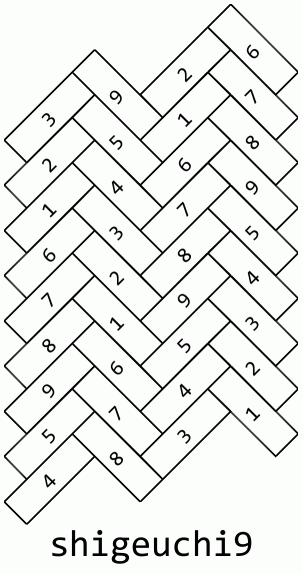
As you can see, every strand follows the same ordering in every column, severely limiting the possibilities. In fact, the standard “clockwise from the top” numbering system obscures the regularity a bit; if you numbered the five strands on the right 1-5 from the top, and the four on the left 6-9 from the top, the numbers in the above diagram would all be in order, which quickly became obvious in my 9-color test braid.
Viable three-color patterns are even harder to find, and the only three I’ve found that are worth mentioning are 111113322 (double zig-zag), 113323332 (crossing double-zig-zag) and 111223332 (sort-of triple-zig-zag). I’m sure there are others, but my script didn’t do a good job of reducing the search space, leaving me with 674 GIFs to pick through.
Amusing enough to get a link...
My family’s coming to town for Christmas, so I went looking for things to do and places to eat. The most amusing thing to show up was this Freedom Festival, which turned out to be an ad for Diaz Brothers Bail Bonds.

"Journalism"
It turns out that Rolling Stone has all the honesty and integrity of Penthouse Letters. Or perhaps less.
I hope no one was surprised.
Uncle Santa's Gift Boxes
The details of the Toys-For-Cops program have been neatly sorted, and while almost all of it is appalling and ridiculous, these two jumped out at me in a quick scan:
Monterey County Sherrif Dept:
    COFFEE MAKER,AUTOMATIC        2   $1,081.52
Monterey Park Police Dept:
    PISTOL,CALIBER .45,AUTOMATIC  5     $293.55
I think we’ve found the world’s worst .45 pistols, and the world’s best coffee-makers.
My own local cops got an MRAP and 30 M-16s, so those vegetable-pickers better mind their manners!
Fast Rope, Tassels, and Speaker Wire
The basic four-strand round kumihimo braid, Maru Yottsu, is a quick and easy way to create a strong braid with simple color patterns.
It’s not a Japanese invention, however, since pretty much every culture in the world figured out how to braid four strands together shortly after the invention of string (or perhaps before, if they had long hair). It can be done on a rope-making stand, a cardboard disk, a marudai, or just with your hands.
Weavers think of it as a way to create tassels and cords, weekend warriors think of it as a way to make tactical climbing rope, and one clever fellow recognized a completely different use, in a comment at the weaving link:
DIY Speaker cable leads. No I’m not kidding.
Weaving four insulated smaller wires in the B-A-A-B pattern results in an Interlaced Dual Twisted-Pair cable. In your example, white would be one twisted-pair, orange is the second twisted-pair. This weave pattern yields a cable of lower electrical resistance, while providing noise rejection that a single thicker wire doesn’t have. Key for high-current delivery and/or to low impedance speakers (exotics, cars). Also great when you only have smaller gauge wire than you want for your application.
...
To get the Interlaced Dual Twisted-Pair noise cancellation, once the weave is done, you cross connect the twisted pairs. Which means: join one white and one orange at one end, join the same two wires at the other end (continuity meter), then join the remaining white-orange wires together at each end. Run your positive/live through one of the new white-orange pair, and the negative/ground through the other.
Extra credit to the guy who built an oversized marudai out of tires to make a 12-strand climbing rope for Crossfit.
[Update: finally found the page I was looking for in The Ashley Book of Knots, where he describes both the finger-braiding method (#2999, 4-Strand Square Sinnet), and using a table (#3037, #3070) that’s basically identical to a marudai. Amusingly, where marudai braiders are extremely finicky about the smoothly-polished texture of the table’s surface, Ashley drives 1-inch brads into the edges to keep the strands neatly separated.]