Computers
Just how 'smart' is that TV?
Reading through the manual for an LG TV, I came across the following line in the notes:
When connecting via a wired LAN, it is recommended to use a CAT 7 cable.
This must be for the Skynet upgrade, so when your TV asks you to upgrade to a 10 gigabit switch and add multiple fiber drops to the house, just say “no”.
I figure it’ll start crying like a little girl when I plug it into the 5-year-old gigabit switch that connects to the 50Mb/s cable line through the house’s Cat 5 wiring.
The Naming of Macs...
“…is a delicate matter”.
There’s a new MacBook Pro waiting on my desk when I get there today. It needs a name.
My first MBP at this company was named Exodar. Once I purchased a much-faster personal one with a Japanese keyboard, named Togetsukyou, I mostly used it for testing and virtual machines. Both flaked out years ago, and almost precisely three years ago they bought me a new one, which I named HelloParty. That one is down to one working USB port, which I should be able to get fixed under AppleCare after I migrate to the new one (giving me a good test machine again).
Other entries in my stable are Mone (Raspberry Pi), Melwin (Mac Mini), Courier (Surface Pro 2), Ririka (old Asus gaming laptop), Bentenmaru (less-old Asus gaming desktop), and Akatsuki (OpenBSD router).
My initial thought, due to the fact that it has the non-tactile touch-strip that replaces the top row of the keyboard, was to call it NoEscape, but that would get depressing after a while.
Currently I’m thinking either Macchi or Sakie. Leaning a bit toward Sakie, because as a laptop it won’t be running headless…
Any other suggestions?
Friday Update
Sort-of-contest extended, because it turns out the Mac that arrived wasn’t mine! I was getting ready to start migrating all my data over, and mentioned being sad about only getting the 512GB SSD instead of the 1TB I wanted, and one of the other guys said, “no, we got approval for the 1TB SSD; this must be someone else’s.”
Visualizing Pi...
So, I bought a Raspberry Pi 3 recently, and since I had no immediate plans to dabble in hardware-hacking, went with the official starter kit, so that I’d get a known tested international power supply, a decent case, and a cute little compact keyboard. (also a three-button mouse and an HDMI cable)
Everything worked perfectly out of the box, including auto-detecting
the 1920x1200 resolution of my little
Eyoyo 10″ monitor. Then I ran the software
updates, rebooted, and poof, no more display. After confirming
that the Pi still booted, grabbing the latest image, and booting in
safe mode, I discovered that the only way to get a fully-updated
Raspbian Jessie or Stretch install to show video on the Eyoyo was to
add something like this to /boot/config.txt:
hdmi_force_hotplug=1 #insist there's a monitor there
hdmi_ignore_edid=0xa5000080 # don't query the monitor
hdmi_group=2 # use monitor-style resolutions
hdmi_mode=69 # use 1920x1200, 60Hz
hdmi_drive=2 # turn on HDMI audio
But then I can’t plug it into anything else without either blindly booting to safe mode or ssh-ing in, changing the config, and rebooting. After a fruitless (heh) search of forums and FAQs, I went through the download archives and found the first Jessie release after the Pi 3 came out (2016-02-26). It worked perfectly. A quick binary search between that and the last Jessie release revealed that the last release that correctly auto-detected my monitor was 2017-01-11. None of the Stretch releases work, and the release notes for Jessie 2017-02-16 don’t have anything that screams “hey we broke the EDID parsing”.
But that appears to be what they did. Adding one line to my config re-enabled auto-detection on the Eyoyo:
avoid_edid_fuzzy_match=1
It came up as 720p, but that’s better than “blank”. Adding this commonly-FAQd line brought it to a more reasonable 1680x1050, while still allowing it to work with other monitors:
hdmi_group=2
So, a quite pleasant out-of-the-box experience, a disaster of an
update, and the recovery process boils down to “mount the SD card on
your PC/Mac, Google for help, then blindly tinker with
/boot/config.txt until you get it working again.”
I suppose this is one way to find all the future sysadmins in your fifth-grade classroom…
I do have one specific project in mind for work. Now that we’re in a new building with lots and lots of windows, I should be able to get a decent view of the sky and build Pi-based stratum 1 ntp servers.
Oh, and I named it Mone. Because inside every Pi is delicious cake.
Update
I just installed FreeBSD 12-CURRENT, which doesn’t support wireless,
but gave me a completely different OS to test against. It bootstraps
itself using the same sort of config.txt, and sure enough, it also
requires setting avoid_edid_fuzzy_match=1 to work with my monitor.
Update 2
Just to round things out, I installed Ubuntu MATE as well, and since it’s not as up-to-date as Raspbian, it auto-detects fine. It’s subtly broken in the typical Ubuntu way (can’t run the GUI software updater, and updating from CLI broke several things, including Firefox), so I won’t use it for anything. I expect that it’ll pick up the EDID bug in the next release.
By the way, I’m booting all this stuff off of a
5-pack of 16GB MicroSD cards, stored in this
cute little holder. This little Anker USB3
card reader is the fastest and most useful
I’ve found for imaging MicroSD cards and mounting the /boot
partition to fix the config file.
Update 3
So, OpenSUSE has a 64-bit build. It installed cleanly, so I let it run a whole bunch of updates, and then I decided to see if the performance was better for things like watching video. So I opened up Firefox and went to Youtube. Or, more precisely, I tried to go to Youtube, because Firefox absolutely refused to open the page, claiming that it used outdated encryption that was evil and fattening and probably voted for Trump. There appears to be no way to say, “just fucking open the site, okay?”.
Baby's First Ruby Script
-
rubygems.org is like someone tried to reimplement CPAN with crayons and a dumpster.
-
most of the Ruby community thinks an API dump is documentation. Some of them don’t even supply that.
-
90% of FAQs assume you’re using Rails. Maybe 95%.
-
I got bad flashbacks to Pascal from having to put function definitions at the top. Yeah, whatever.
-
“our {} is different” will trip me up for years.
-
not being able to freely break lines mid-expression is annoying.
-
googling for help always returns obsolete 10-year-old results (“thanks, pagerank!”).
-
manual type conversion == stone knives and bearskins.
-
riis like someone tried to reimplementperldocwith chalk. In the rain.
Anyway
I had a tiny project that had minimal dependencies. The Perl version flowed from my fingers like water, naturally, but the logic was trivial, and all it needed was a TOML parser and some random numbers, so it seemed like it would be easy to try out in Ruby. And I can even say something nice about the language: shuffle() and uniq() are core array methods.
A related script generates an improved Japanese Diceware ruleset using JMdict, but I haven’t found a full-featured romanization gem, and the advice about XML parsing is all over the map. Perl’s XML::Twig and its simplify() method have really spoiled me; I ended up having to mix Nokogiri::XML::Reader with Nori.parse, and then write my own force_arrays() function to emulate one of the most useful features of simplify(). The result is still only a crude approximation of what I can do with XML::Twig, but it suffices for this project.
While I’m complaining, the following gang-bang expression is not equivalent to the assignment version, which produces a sorted random unique subset of the array. Instead, you get the unsorted complement of the desired slice, unless the array was already unique, in which case Ruby blows chunks. This is, um, non-obvious.
words.uniq!.shuffle!.slice!(0,7776).sort!
words = words.uniq.shuffle.slice(0,7776).sort
On an unrelated note, I was amused to discover that the only useful PDF-generating gem still doesn’t support clipping paths, and while the authors claim it can easily be extended to support additional low-level PDF operators, that feature is not mentioned anywhere in the documentation or code…
Why play with Ruby in the first place? An old friend and on-again co-worker is a real zealot. Of course, our uses of scripting languages are very nearly orthogonal, to the point that many of the reasons I keep bouncing off of Ruby are things he never sees.
And, yes, I continue to be offended by Python’s use of indentation, although I’ll tolerate it at small scale to play with Ren’Py and CircuitPython. It’s heavily pushed on the Raspberry Pi as well, but at least there I can run Emacs and Perl, as Ghod intended.
Dear Amazon,
The Amazon Basics Computer Speakers are not well-shielded, and by that I mean they pick up local radio stations when the volume knob is at roughly 50%, and my hand acts as a convenient antenna when I adjust the knob. This defect is well-known, but buried by the mostly-positive reviews.
Apparently some people have had luck playing RMA roulette, but it’s pretty faint, so I think I’ll just ask Todd for some ferrite beads. Useful having a fully-stocked hardware department in your company. (and ohboy is it going to be fun to move that to the new building next month; some of his stuff isn’t going to fit into the elevator…)
Update
Found some ferrite beads around the house, and adding them didn’t help. The radio signal was stronger this morning, enough that I could understand the ads, so back they go. Fortunately there’s an Amazon locker at the mall, so all I have to do is drop them off on the way to work.
Replacement!
Friday morning I dropped off the RMA and ordered these instead for $3 more. They’re the best-seller in the category, and it looks like I bought them just in time, since they’re out of stock now. With standard two-day Prime shipping, they were on my porch Saturday morning when I went out to feed the cats. They’re about twice the size of the Amazon Basics speakers, with much better sound, and no radio interference.
New Toys
My 7″ 1280x800 monitor got a bit flaky during the data center move, and while it survived, the screen quality will never be quite the same, so I picked up an Eyoyo 10″ 1920x1200. The blindingly bright blue power LED needed covering with gaffer tape, but the image quality is excellent, and it even has speakers. Works great with my Mac, but even though my Surface Pro 2 detects it and shows its resolution, for some reason it doesn’t send a video signal out to it via HDMI. I tried two different mini-Displayport adapters and a brand new high-end cable, so I suspect HDCP handshake issues.
[Update: there’s something a bit odd about the Eyoyo monitor; when I first plugged it into my new Raspberry Pi 3, it worked perfectly, including showing the splash screen, but ever since, it only works if I force-select a video mode. Still works fine with the Mac, but it simply cannot auto-sync with the Pi, or show anything from the Surface Pro 2, which makes it “less than versatile”]
While setting up my cube in the new building (which included swapping the desk pieces around and adding a partial roof), I decided to ditch the crufty old USB2 hub I was using in favor of an Anker 10-port USB3 with fast charging support. Mostly because the right-hand USB port on my MacBook Pro went out a while back. Maybe after the holidays I’ll send it in for service; I think the AppleCare runs until February.
Those were easily justified purchases, but in the nearly-pure toy
department, I picked up a TrueRNG3 USB
hardware random number generator. Automatically supported in Linux,
works on a Mac if you manually send the output to /dev/random, and
they have a Windows driver. Sadly, while OpenBSD 6.2
supports several USB HRNG, it looks
like the TrueRNG isn’t one of them. Yet.
I don’t have dieharder test output from it at the moment, because it only delivers 50 KB/s of random bits, but ent really likes its output. The vendor claims to pass the dieharder tests, but doesn’t say how long it took to generate enough samples (some of the tests consume a lot of bytes).
Why am I trying to improve the quality of my random numbers? Because I’ve been playing with random passphrase generation again, using a rule-based generator that lets me feed in a variety of patterns and dictionaries, for Diceware-style generation with calculated entropy. For instance, one script generates an improved romanized Japanese diceware list, based on the word-frequency rankings in JMdict, and I can do side-by-side comparisons between different lists to see how easy the results are to remember. Side note: the EFF wordlists are a nice improvement on the original English 5-dice lists, and they’ve got two nice 4-dice lists as well, with interesting properties.
For real fun, I set my generator up to allow mixing multiple rulesets, which is a relatively minor increase in entropy, but definitely more entertaining (especially if you include the Lord Of The Rings ruleset…).
And it also let me prototype an updated syllable-based system using polyhedral dice. Cut out and save!
+--------------------------------------+--------------------------------------+
|     Random Passphrase Generator      |      Digits, Specials, Uppercase     |
|                                      |                                      |
|  1  2  3  4  5  6  7  8  9 10 11 12  |     1  2  3  4  5  6  7  8  9  0     |
| -----------------------------------  |     @  #  %  $  !  |  &  _  ,  :     |
|  s  v  p  h  f  k  r  t  j  m  w  b  |     A  B  C  K  N  Q  T  X  Y  Z     |
|                                      |     +  -  *  /                       |
|       1   2   3   4   5   6   7   8  |                                      |
|   +--------------------------------  |     d12 * d8 * d6 = 9.17 bits        |
| 1 | eth  id  ol  eg  od  az  it  el  |     var/op/digit = 8.64 bits         |
| 2 |  ug  og  an  as  on  ar  is  al  |     d10 = 3.32 bits                  |
| 3 | ath  ay  ot  iz  us  os   a   e  |     d4 = 2 bits                      |
| 4 |  et  il   u  ed  ig  uz oth   o  |                                      |
| 5 |  oy  ul  ag  en  un  oz  or  es  |     10 syl ~ 14-char random ASCII    |
| 6 |  ad  ez ith  ut   i  ud  in  at  |     12 syl > 16-char random ASCII    |
+--------------------------------------+--------------------------------------+
(this table shouldn’t wrap on most screens, but for some reason it does in Chromium on my shiny new Raspberry Pi at 1920x1200, unless I zoom the font size to 80%, 110%, or 200%; some odd scaling in the version of Bootstrap I’m using, I guess)
Most people never find the old Diceware tables for generating syllables, special characters, etc. They’re buried in the original mailing-list post for Diceware, and aren’t referenced in the current HTML pages. Most of them aren’t particularly useful, but if your password policies require some combination of upper-case, special characters, and digits, they’re better than just appending “A1!” to every password. My var/op/digit rules above exist for the same reason; I find it pretty easy to remember “Z/4” or “X+2”.
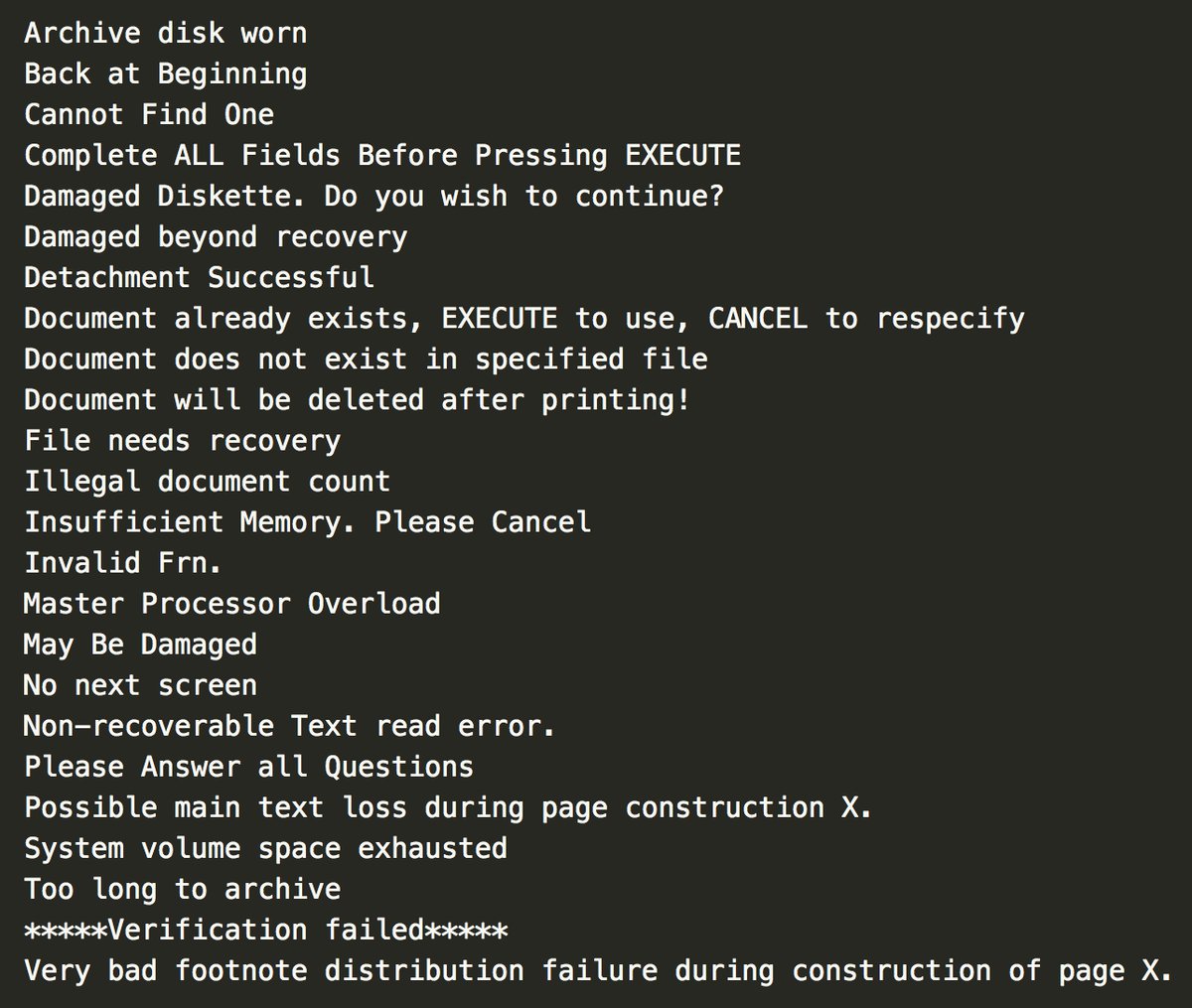
What could possibly go wrong?
Scott reports, you decide:
My gaming laptop started getting really flaky (first one USB port went, then two more, then the wireless and HDMI out, etc) a couple of weeks ago, so I ordered a brand new Alienware 15. It arrived on Wednesday and I started the process of downloading and installing Windows updates, Steam, Fallout 4, etc. The only problem was that it kept going to sleep during the downloads. No matter what I changed in the power settings, it kept going to sleep.
As it turns out, some idiot at Dell thought it would be a good idea to install and enable by default eyeball tracking software that puts the laptop to sleep if you look away from it for “too long”. (Where “too long” is no more than a minute or two.) Needless to say, that package has been removed from the machine.
There’s a short story just begging to be written here, where an enterprising hacker releases ransomware that, instead of asking for bitcoins, hijacks the eye-tracking software and demands that you watch ads all day. Or just shouts “show your tits!” whenever it detects a college girl using a laptop.