“Unfortunately, common sense is just not common. We have to regulate every aspect of people’s lives.”
— Santa Barbara Councilman Strawman Jason DominguezPixiv Champloo 7
Server rebuilt, data verified, meal cooked and eaten, episodes of Senko-chan watched. Now loading… cheesecake!

A few small repairs...
Early yesterday morning, I got email from a server whose RAID 10 array was rebuilding. As far as I could tell, one of the SSDs had briefly gone offline, just long enough to force the controller to resync it.
Mildly disturbing. I told the team to make sure we had a cold spare ready to go, and we should prep to swap it in if we saw anything else unusual before we had a chance to schedule a maintenance window.
Early this morning, two SSDs failed in that server, and this did not include the one that blipped yesterday. That reeks of RAID controller failure, and since we didn’t have an identical one on hand with identical firmware, the best bet was moving the whole damn thing to completely different hardware (more precisely, our shiny new VMware/Tegile cluster).
Fortunately it’s only half a terabyte, backed up at least three different ways, and everything’s on a 10G network, but pretty much all of engineering is twiddling their thumbs until it’s back, so “no pressure”.
Update
Start to finish, it took about 7 hours from the time we pulled the trigger on the move. A good chunk of that was spent checksumming the data and copying back the dozen or so files that were corrupted.
Now I’m just watching the rsync backup run with “-c” to make sure the corrupted data didn’t propagate. Honestly, it would be faster to blow away the destination and do a regular rsync, but then I’d have one less mostly-valid backup for N hours. I don’t really care how long it takes to run, and doing it this way reassures any management types who ask questions later.
Isekai Overload...
Magical Terrapin Andii says:
“There is a manga series about a guy who started out as a slime in a fantasy world, died, and got reincarnated as a Japanese office worker.
“Still haven’t found ‘That time my smartphone got reincarnated as a spider farm’ but it’s probably in there.”
Having some “experience” in the field, may I offer a few suggestions that may aid your search?
- Isekai Uncle
- Isekai Orphanage
- Isekai Pharmacy
- Isekai Relaxing Farmhouse
- Isekai Adult Video Film Crew
- Isekai Magical-Girl Wand/P
That last one’s for Pete (who I’m sure has already read it…), and the full title is: “異世界で最強の杖に転生した俺が嫌がる少女をムリヤリ魔法 少女にPする!”, in which Our Hero, a magical-girl otaku, gets hit by a truck while saving a little girl, summoned to another world by a busty, scantily-clad sorceress, and reincarnated as the strongest magic wand. Annoyed that a world full of magic doesn’t have magical girls, he becomes the Producer for a busty, scantily-clad young beauty, and works to overcome her reluctance, shyness, and crippling lack of self-esteem to groom her into becoming his new world’s first true (busty, scantily-clad) magical girl.
F'real shakes
During the long drive back from Mt. Hood, I stopped for gas somewhere, and found something I hadn’t seen before: a self-serve milkshake machine from F’real. You select your flavor from the freezer, load it into the machine, select your preferred thickness, and wait for it to spin up and aerate your shake. Not bad at all, but I can’t say I’d go out of my way for one. I mean, their web site says there’s one at an ExtraMile just off the highway in Gilroy, but the map shows that it’s right next door to a Sonic…
Downside: it’s too slow to deliver any non-trivial volume of shakes. If there had been even one person in front of me, I might not have hung around waiting, and if there had been more, forget about it. Given that it takes up a fair amount of counter space, I suspect it’s going to be a hard sell for many gas stations and truck stops, and will quickly be replaced with something less tasty but much faster.
The Fuckin' Union That Works For You...
…and by “you”, they mean “them”, suckers!
Cop Craft 7, 8, 9
I was AFK for a week, then busy at work for a week, so it’s catchup time!
Episode 7 starts off quick, with Tirana already undercover as fresh meat in an expensive brothel. I’d have liked to see the awkward fun of getting her into that situation in the first place, but the real point of the story is getting her to make friends with another of the girls, the cute short-haired elf from the OP.
From her appearance with a camera, I’d assumed she was Spunky Gal Reporter. Sadly, Friendly Whore Selling Secrets is not a trope that comes with a long lifespan. Pity; I was hoping for a little grown-up cheesecake to balance out Tirana’s lock on the lolicon market.
It ends with her determined to avenge her murdered friend, so naturally the next episode and a half are spent on Wacky Hijinks and (literally) mindless fan-service after a rogue magic item body-swaps her with the cat.
Episode 9 (after finishing off the cat/girl tale) starts off with Kei being an annoying prick to his co-workers, so, y’know, same-old-same-old, but poolside, with Tirana sporting new and more confusing headgear to go with her school swimsuit. The plot thickens, slowly, until we’re pretty sure that Villain #1 and Villain #2 are both involved. Or is it Villain #2A? Next episode.
And, yes, the headgear and the swimsuit mean precisely what you think: they’re up to book 6. You might ask what happened to all the story material in the middle. Well, better learn to read Japanese and go buy the light novels; last time I checked, all 6 were in the top 20 on Amazon Japan.
Labor Day...
This is not an accurate illustration of how I spent the 3-day weekend, but I did do some cleaning and laundry, and ripped out a bunch of dead bamboo.


This is not quite how I’ll be relaxing after…
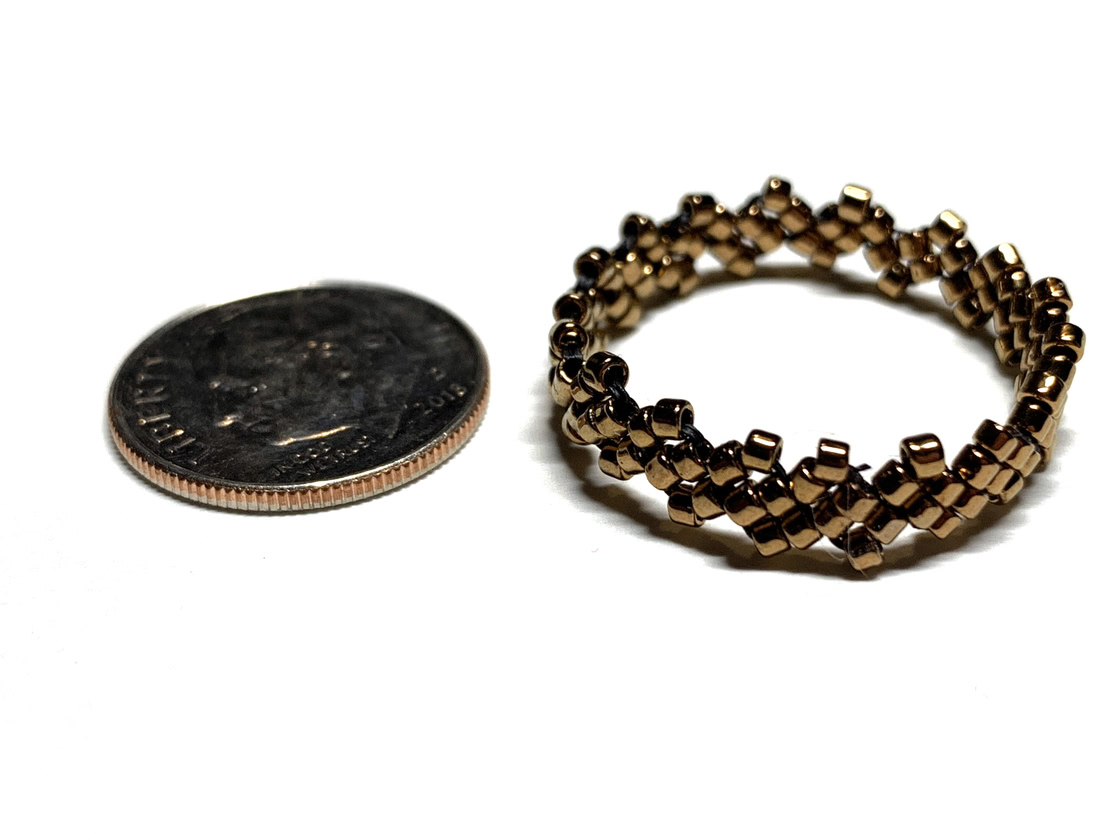
Toho Peace Ring
One of the side activities at the Retreat was labeled Peace Ring, which had a kind of hippie-drum-circle sound to it. Fortunately it wasn’t, although I found it taxing for a different reason: I’m rubbish at sewing together tiny beads.
But I gave it a shot anyway, and can proudly say that I almost managed three rows before politely giving up; well, technically I managed two rows twice, with different errors. The first problem was that the photocopied instructions were tiny and low-resolution. That was solved when someone who had the original PDF made a quick run to the hotel business office, but even the readable instructions were iffy for a novice. The second problem was the diffuse lighting in the conference room, and while my glasses allowed close focus, they lacked magnification.
It would have gone a lot more smoothly if they’d illustrated the technique with something larger than 11/0 seed beads; still tricky, but at least I’d have known what I was doing. So I made a note to dig out a bunch of cheap wooden beads and some string when I got home, to figure out the technique.
Final result:
After the jump, scaled-up pictures of the steps in the PDF: