“The only two white actors in Black Panther are Martin Freeman, who played Bilbo Baggins, and Andy Serkis who played Gollum. They’re the Tolkien white guys.”
— this guy among othersAnime update: Kaleido Star, disc 5
After watching discs 1-3, I described this as one of the best anime series currently running. Disc 4 cemented that opinion, and was so good that I didn’t want to say anything for fear of spoiling it.
On disc 5 it gets better.
Much of what happens is expected, and some of it is even predictable, but in the final scene of the fourth episode on the disc, they casually drop a bombshell that has the potential to change everything. And it makes perfect sense.
The only thing that kept me from spraying my drink across the room in surprise was the fact that I’d just finished it.
Snowball, Infernal, Improved Chances Thereof
What appears to be an op-ed in Germany’s largest newspaper is getting a lot of attention for endorsing Bush, and laying out the reasons he’s a better choice than Kerry.
My German is far too shaky for me to tell if this is the paper’s official endorsement or “the opinion of one of our columnists,” but either way I can see heads exploding on both sides of the Atlantic. This site appears to have an accurate translation of the reasons given in the article. It’s, um, refreshing reading, and far more sane than the hallway conversation I had today at work.
I've seen worse political quizzes
This one isn’t bad. It correctly divines that while no one truly represents me (“ideal theoretical candidate”, 100%), I’d generally be inclined to vote Libertarian (Badnarik, 69%), if it weren’t for my compelling interest in the survival of western civilization (Bush, 63%).
It puts Kerry at 44% for me, but it’s not clear how recently they’ve checked his positions on the issues. I’ll have to try again tomorrow and see if the same answers produce different results…
More iPod Roadkill
Pretty much every new portable music device that comes out is evaluated for its potential as an “iPod-killer”. I’m sorry, but as long as they keep building things that look like this, they’re not the killers, they’re just a flat patch of fur on the side of the road.
Traveller PDF mapping
Sunday was a pretty slow day, so I wrote a Perl script that generated PDF hex-maps for use in the Traveller RPG (we’re starting a D20 Traveller campaign soon). I also integrated star-system data from the standard SEC format that’s been passed around on the Internet for many years, and I’m adding an assortment of features as I find time.
Currently it prints at the sector, quadrant, and subsector level, in color and b&w, on paper sizes ranging from 4x6 to 11x17. All the heavy lifting is done with the PDF::API2::Lite module from CPAN, which has a straightforward interface.
Update: I seem to have pretty good page-rank with Google, so just in case there’s anyone else out there who’s trying to set a clipping region with PDF::API2::Lite, the magic words are:
#create some kind of path, like so
$pdf->rectxy($x1,$y1,$x2,$y2);
#clip to it
$pdf->{hybrid}->clip;
#start a new path
$pdf->{hybrid}->endpath;
Note that this doesn’t seem to work with the alpha 0.40 versions of the PDF::API2 distribution. I’m using 0.3r77.
Mock election mocks Kerry
LGF links to the mock election held by Channel One (a satellite broadcaster targeting 12,000 middle/junior/high schools in the US). Their last two mock elections have apparently matched the actual results pretty well, so who did they pick for president? The picture says it all:
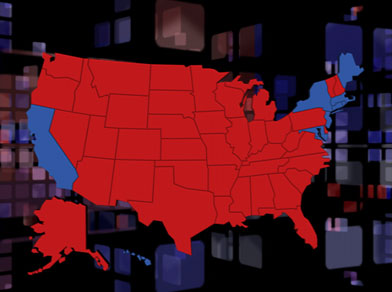
That’s 73% of the electoral votes for Bush, 27% for Kerry. Personally, I’ve been betting on 60/40, but can you imagine how the wackier Lefties would respond to these results?
Random thought for the day
Dinner tonight was based on a curry mix I picked up at Mitsuwa. I think all packaged foods should include the instructions “break sauce into pieces”.
T-shirt, please
This needs to be a t-shirt, so I’ll have something to wear when Celebrate Diversity is in the wash.