“Alcohol is like love. The first kiss is magic, the second is intimate, the third is routine. After that you take the girl’s clothes off.”
— Raymond ChandlerYeah, we're geeks; deal with it.

You don't know them
If you hang out with fans long enough, eventually you’ll hear something like this:
"I think we 'know' our idols better than their casual friends do."
This doesn’t just come from creepy stalkers, although it’s certainly how they get their start (“Hi, Mike! Been thrown in jail again yet, or have you finally stopped projecting madonna/whore complexes onto total strangers whose albums you buy?”). It may be most common with celebrities whose careers are built on selling an image, but every field has fans who feel a personal connection to the creator of the works they idolize. With multimedia idols, though, it’s much more pervasive; fans have watched them on stage, fooling around backstage, getting annoyed in interviews, breaking down in tears, getting flustered by personal questions, etc, etc, all contributing to a feeling that they’re able to see through the editing to The Real Person.
Dear SNMPD,
When you alert me that a server is running out of swap space, I really don’t want to log in and find out that you’re the one using up all of the virtual memory.
Wet seal
On Saturday, the city informed me that my street will be “slurry sealed” on Tuesday, blocking all traffic in and out between 7am and 5pm. We’ve also been asked not to water lawns or wash cars that day. I have two predictions.
-
some cars won’t get moved because their owners took Thanksgiving week off and are already out of town.
-
the sealing work will look awful and have to be redone, because if runoff from sprinklers can affect it, the 11 hours of rain that’s currently predicted will really wreck the job.
No doubt this planning was done by the same genius responsible for taking a 40 MPH corner that went around a vacant lot and converting it into a 15 MPH corner that goes around a major shopping center. And the frequent damage to the new guardrail demonstrates that they’re not kidding about the 15 MPH.
I’ll be staying at a motel tonight. The alternative is over-sleeping by ten minutes and being forced to skip class and work from home. Given the logistics of the thing, they’ll start with circles and dead-end streets, so even if they quit early because of rain, they’ll be doing my block first.
Service! Service!
Coming to Japanese tv in January: Asu no Yoichi, a fish-out-of-water harem comedy about a young swordsman who ends up living with and studying under a Rushuna-scaled high-school girl.
The manga is up to seven volumes now, so perhaps it’s developed a solid story since I commented on the first one. At the very least, there’s enough material that they shouldn’t have to resort to random filler episodes.
Bare-bones home-page here.
Apple US goes International
For a long time now, when you order a laptop directly from Apple’s web site, you’ve been given the choice between US and Western Spanish keyboards. With the latest models, they’ve added French and Japanese keyboards (and matching user manuals) for both MacBooks and MacBook Pros, with no effect on the promised shipping time.
The new one will have to be a Pro, since they’ve ripped FireWire out of the base MacBook line and once again left out the expansion slots. Which means that I really can’t justify the expense right now. I mean, for what it would cost to buy a tricked-out MBP, I could buy the new Sinolta 25-megapixel camera body, and I can’t justify that, either. Right now I’m barely using the extremely nice camera gear I already own, and we’re headed into the rainy season. And the current laptop is a 2GHz Core Duo with 2GB of RAM and a 250GB hard drive.
I’m not buying either Really Cool Toy. This year. Spring, maybe. Yeah, that’s it, Spring. The economy can wait until then for major new contributions from me. I might need a new car by then, too. My 2002 RX-300 has over 200,000 miles on it, and Lexus is promising that the new RX-450h will be showing up around then.
Also, my company will have had the chance for real holiday retail sales, the current product will be available in a lot more stores, and we’ll be showing off our next-generation product, so I might even be able to afford all three upgrades. Or get the company to spring for the laptop and buy the other two. :-)
Words I never thought I'd hear...
From the nice folks at Lexus, on their new in-car control system:
Remote Touch is as natural to the driver's hand as a computer mouse.
So, expect to hear about a lot of car-pool tunnel injuries in a few years.
Smoked visitor
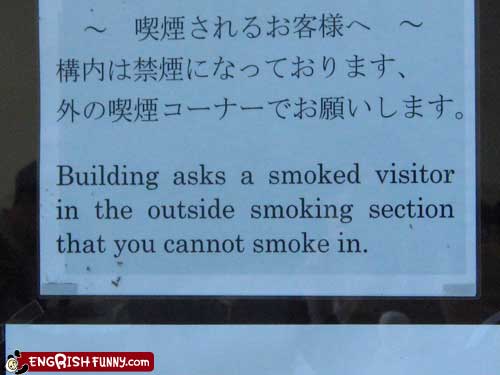
The sign reads:
〜 喫煙されるお客様へ 〜
構内は禁煙になっております、
外の喫煙コーナーでお願いします。
Literally translated, it says: “To respected customers who (honorably) smoke tobacco: the premises have humbly become non-smoking, we request (you do it) at the outside smoking corner”.
The English translation is broken in a number of ways, but the most interesting part is “smoked visitor”, because it demonstrates that the translator wasn’t fluent in Japanese. The verb conjugation sareru is the passive form of suru, “to do”, so the first line really does say, “to visitors who are smoked”, but no one who speaks Japanese would interpret it that way. The context makes it painfully clear that this is the passive honorific form, and the honored visitor is the smoker, not the smokee.
So, we have a translation done by someone who doesn’t speak English or Japanese, better known as a computer. Without knowing how long ago the sign was made, it’s impossible to determine which software, but here are some modern attempts.
Babelfish (and anything else based on SYSTRAN, including Apple’s translation widget) produces something that’s almost English:
- To the customer who smokes -
the enclosure we have become prohibition of smoking,
we ask with the smoking corner outside.
Google’s attempt is poetic, but incomprehensible:
Smoking to be one of your
Smoking is on the premises,
In the smoking area outside.
Reverso, one I’d never heard of before, gives something that looks quite familiar:
I ask a smoked visitor for the yard at the outside smoking corner that smoking is prohibited in.
Paralink’s translator offers a nice contradiction:
Customers will be smoking on campus is a non-smoking, smoking outside corner.
Windows Live thinks different:
and smoking that is customer to premises smoking and: on the outside smoking corner in.
The Japanese site OCN has an interesting answer:
Premises at the outside smoking
area which becomes no smoking
to the customer who smokes, please.
Another Japanese site, @Nifty, gives this:
- Visitor smoked -
please give me premises in the outer smoking corner which is giving up smoking.
I won’t dignify Animelab’s web form with the term “translator”, but they give a link to Excite, which produced this:
?To the customer from whom it smokes?
I hope premises in the smoking corner of the outside that is nosmoking.