Pics and plates
Disturbingly accurate, but also deeply wrong

Still going…

New DOGE recruiting poster

Google AI: always confidently wrong
I searched for “otagiri history”. Random facts were merged together:
Otagiri Mercantile Company (OMC), based in San Francisco, was a prominent manufacturer of ceramic Tiki mugs, particularly in the 1960s and 70s. The company produced the majority of its mugs in Japan and was known for its Polynesian-inspired designs. OMC was eventually acquired by a larger corporation in the mid-1990s and ceased production of its line of Polynesian ceramics. Additionally, there’s a notable connection to Otagiri in the context of the US Navy Japanese/Oriental Language School during World War II, where J.G. Otagiri served as an instructor.
It does link to its sources, but fails to provide any reason to connect them in this way.
Actual facts, which can be derived by completely ignoring the prominent “AI” summary and reading through the buried search results:
-
Otagiri is a mildly-collectible brand of handmade dinnerware, made by a variety of Japanese kilns from the late Fifties through the mid-Nineties. Several American designers were hired to provide Hallmark-ish designs (not for tiki mugs). It’s widely available on Etsy and eBay at reasonable prices, and every once in a while new old stock turns up in Japanese warehouses, often from patterns that never made it to the US (Umami Mart used to sell coffee mugs they found in the warehouse of Kenzan Ceramics, some of which had Otagiri branding).
-
They also imported ceramic tiki mugs, chickens, turkeys, houses, music boxes, etc, as well as some decorative laminated platters.
-
The importer has no documented connection to anyone by the name “Otagiri” (小田切 = “small field” + “bounds”).
-
Further down under “other connections”, it finally says “Otagiri was also a well-known dinnerware company, particularly for its pottery, known for its firing and glazing techniques”, not recognizing that it’s the same company.
-
It also cites a phony book on Amazon that clearly exists just to sucker people who search for the word.
-
Finally, it links to the Wikipedia article for Otagiri Dam, which qualifies as “otagiri history”, but has no known connection to any of the others.
Why do I know any of this? Because a while back, my mom was sorting through stuff that’d been in boxes through multiple moves, and she handed me a small lidded crock and said, “I think you’ll like this, it feels very Japanese”. I turned it over, saw the name and country of origin, and googled the sticker. Then I checked the labels on the coffee mugs I’d previously bought from Umami Mart, and sure enough, one of them had the same Otagiri sticker.
Later I found a few nice-looking affordable pieces in the same pattern (Bittersweet) and bought them. I now have a number of their more decorative plate designs on the wall in my dining room, as well as a slowly-growing collection of that pattern. I was briefly tempted by a very complete dinner set of Bittersweet, but you had to pick it up in person in Monterey and I’d just left California forever.
I also discovered that there are a number of “Otagiri-like” patterns for sale online, almost all of them unlabeled, and based on the similarity in design, I suspect there were other importers working with the same Japanese kilns.
These, for instance, have the exact same size and shape as Otagiri soup mugs and bread plates, but don’t match any known set:
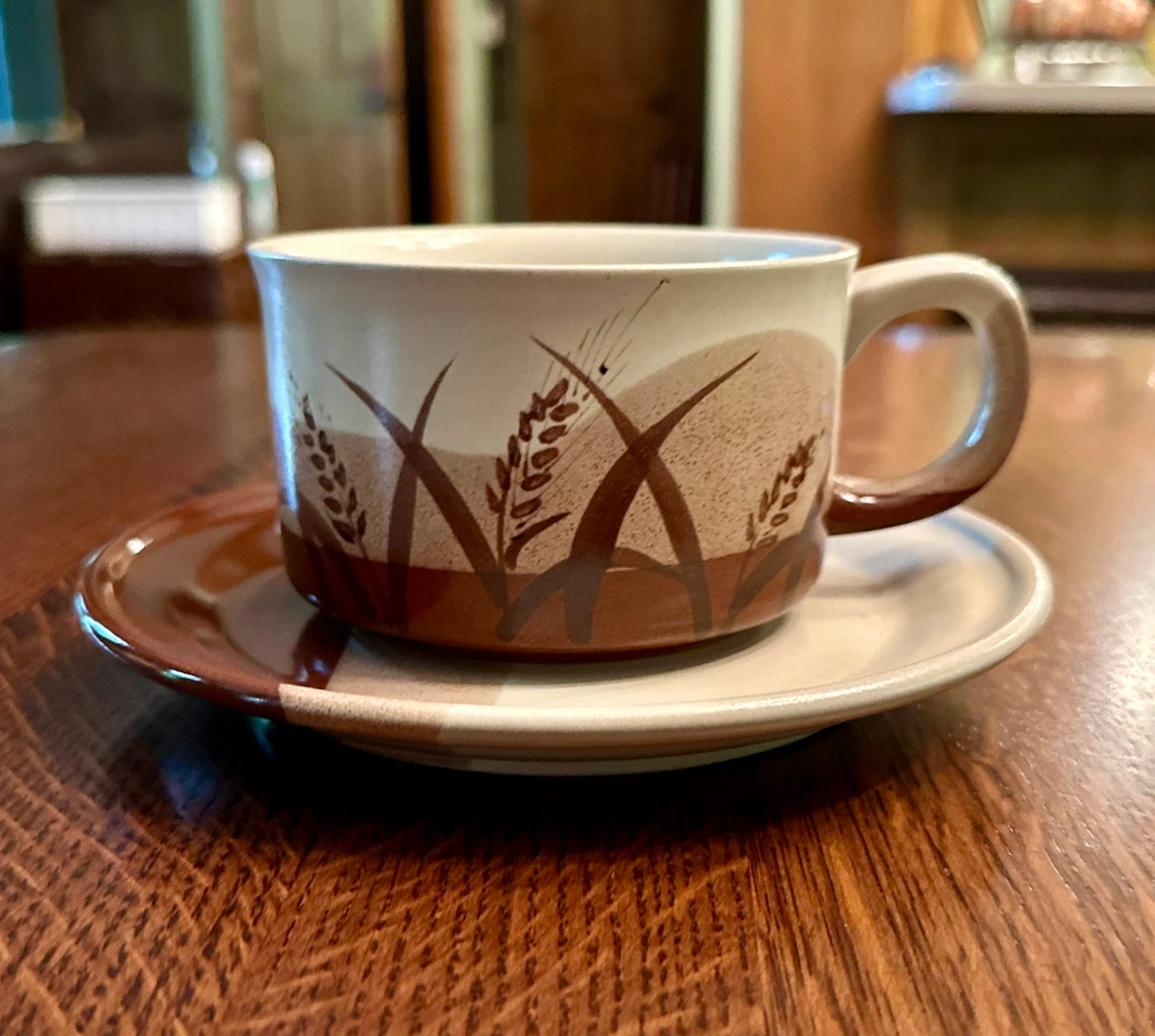
One reason a lot of Otagiri pieces are unlabeled is that the importer initially used a gold sticker on the bottom for their branding, and people often removed it or washed it off. The only reason we have official names for most of the patterns is that they later switched to stamping/painting the details on the bottom (likely when they filed their US trademark in 1980). I’ve also seen it claimed that the stickers were only added once the crates were unpacked in San Francisco, but the mug I got from Umami Mart had it applied in Japan.
By the way, Kenzan Ceramics doesn’t make coffee mugs and dinner plates any more; they’re strictly high-end wall and floor tile. I guess the export business got them through some lean years while they were establishing their business.
Comments via Isso
Markdown formatting and simple HTML accepted.
Sometimes you have to double-click to enter text in the form (interaction between Isso and Bootstrap?). Tab is more reliable.